1903 Nobel Prize in Physics(1)
Reason for Award
for the discovery of spontaneous radioactivity
Laureates
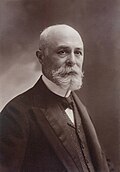
 France
Explanation
At the end of the 19th century, Mr. Becquerel was studying a rock called uranium. He placed the uranium on a photographic plate wrapped in black paper, planning to expose it to sunlight. Because the weather turned cloudy, he put the plate away, but later found it had turned completely dark even without sunlight. That meant the uranium itself had emitted an invisible energy that fogged the film. Such a property of giving off energy on its own is called “radioactivity.” This curious discovery became the first step toward technologies like nuclear power and hospital X-ray imaging.
Related Keywords
radioactivity
Radioactivity is the property of an atomic nucleus to transform into another nucleus or particle while releasing energy. The released energy may appear as alpha, beta, or gamma radiation. Each radionuclide is characterized by a “half-life,” the time it takes for its activity to drop to one half. Radioactivity is useful for medical imaging, age dating, and power generation, yet strict safety measures are essential because of health risks. Becquerel’s discovery showed that matter can be intrinsically radioactive, opening a new window on atomic structure.
uranium
Uranium is a metallic element with atomic number 92 and is among the heaviest naturally occurring elements on Earth. Its main isotopes, U-238 and U-235, are both radioactive and possess very long half-lives. Many uranium compounds exhibit yellow-green fluorescence, a property exploited in Becquerel’s original experiments. Uranium is used as fuel in nuclear reactors and weapons, and its decay chain underlies uranium–lead geochronology. Studies of its spontaneous decay played a pivotal role in the development of nuclear physics.
Becquerel rays
“Becquerel rays” is the historical term Becquerel used to label the unknown radiation he observed. It was later understood to consist of several components: alpha, beta, and gamma rays. Because distinguishing them from X-ray-induced fluorescence was challenging at the time, the term emphasized the empirical nature of the discovery. Although rarely used today, it remains an important keyword in historical literature. The concept paved the way for recognizing the diversity of radiation and the particle–wave duality of its components.
photographic plate
A photographic plate is a glass or film coated with a light-sensitive emulsion, the primary image recorder of the 19th century. Becquerel exploited the darkening of such plates by radiation to visualize invisible rays. Because the degree of blackening is roughly proportional to dose, a plate can serve as a rudimentary dosimeter. Although later supplanted by cloud chambers and Geiger counters, photographic plates formed the foundation of early radiation detection. They also found extended use in astronomy and particle physics for recording meteor tracks and cosmic-ray events.
half-life
Half-life is the average time required for half of the nuclei in a sample of a radioactive isotope to decay. Radioactive decay is stochastic; while individual atoms behave unpredictably, large ensembles diminish at a constant rate. The half-life of U-238 is about 4.47 billion years, making it a marker for geological timescales. Understanding half-lives enables safe planning for medical isotope dosage and nuclear waste management. Activity expressed in becquerels is determined by half-life and material quantity, forming the basis of radiation dose assessment.