1961 Nobel Prize in Physics(1)
Reason for Award
for his pioneering studies of electron scattering in atomic nuclei and the resulting discoveries concerning the structure of the nucleons (Phys. Rev. Lett. 5 (1960) 263–265; Phys. Rev. Lett. 6 (1961) 293–296)
Laureates
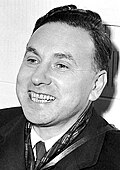
 United States of America
Explanation
Everything around us is made of tiny particles called atoms. At the center of an atom lies an even tinier nucleus filled with protons and neutrons, together called nucleons. Robert Hofstadter sped electrons up to nearly the speed of light and fired them at atomic nuclei. By measuring the directions and speeds of the electrons that bounced back, he could infer the shape and size of the nucleus. It is like throwing balls at a wall in the dark to guess what the wall looks like. In this way he was the first to show clearly how large nucleons are and how their electric charge is spread out.
Related Keywords
electron scattering
Electron scattering fires high-speed electrons at matter and measures the outgoing angles and energies to probe internal structure. Because electrons behave as point-like particles and their Coulomb interaction is well understood, the method offers very high analytical accuracy. In Hofstadter’s work the angular dependence of the cross section was crucial for extracting nucleon form factors. Today, electron scattering is also used in accelerator physics and materials science, providing atomic-scale images. Quantifying nucleon size and charge distribution was a landmark achievement.
nucleon
A nucleon is the collective term for the proton and the neutron, the basic constituents of atomic nuclei. They experience the strong interaction and contain quarks and gluons. Before Hofstadter they were often treated as point-like, but electron scattering showed they have a finite size. The radius of roughly 0.8 fm is a benchmark for many theoretical models. Nucleon properties also affect our understanding of stellar interiors and neutron stars.
charge distribution
Charge distribution describes how electric charge is spread inside a particle. From electron-scattering angles one can reconstruct it by inverse Fourier transform. The distributions of nuclei and nucleons test spatial aspects of the strong interaction. Hofstadter’s data showed that the proton’s charge density falls approximately exponentially. Later comparisons with lattice-QCD provided critical theory tests.
form factor
Form factors are scale-dependent functions that modify scattering amplitudes to account for internal structure. They show how the observed cross section differs from scattering off a point charge. The electromagnetic form factors of nucleons are Fourier transforms of their charge and magnetisation distributions and vary with Q². Hofstadter measured them over a wide Q² range and proposed the dipole approximation. They remain vital inputs to neutrino-scattering and parity-violation experiments.
linear accelerator
A linear accelerator uses electric fields to accelerate particles along a straight path. Particles gain energy each time they pass through a series of cavities. The Stanford linac was indispensable to Hofstadter’s experiments. Linacs are also used for medical X-ray machines and free-electron lasers. Modern superconducting designs aim to accelerate particles to tens of GeV.
nuclear radius
The nuclear radius is an average length scale that characterises the size of a nucleus or nucleon. It is defined from the root-mean-square of the charge distribution. Hofstadter fixed the proton radius at about 0.8 fm, setting a standard for later experiments. The radius is a key parameter for reaction cross sections and nuclear density calculations. It also influences neutron-star models and atomic-clock research.