1963 Nobel Prize in Physics(1)
Reason for Award
for his contributions to the theory of the atomic nucleus and the elementary particles, particularly through the discovery and application of fundamental symmetry principles
Laureates
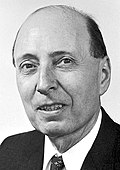
 United States of America
Explanation
Mr. Wigner studied the idea that some things remain the same even when you flip them like a mirror or turn them around. With this idea, called symmetry, he could predict how tiny particles smaller than atoms move. It’s like knowing that marbles roll the same way in two boxes that have the exact same shape. By discovering these symmetry rules, he showed that the invisible world follows the same patterns we see around us. This helped scientists understand why energy is saved and how light is released. The knowledge now supports power stations and the electronics we use every day.
Related Keywords
symmetry
A property stating that physical laws remain unchanged under operations such as spatial inversion, rotation, or time reversal. Wigner demonstrated that symmetries generate conservation laws. They are widely used to classify particles and to formulate selection rules for transitions. The same mathematics appears in semiconductor band structures and crystallography. Today’s Standard Model is built upon gauge symmetries.
group theory
A mathematical framework for handling sets of symmetry operations. Wigner introduced Lie and discrete group representations to organize quantum-mechanical matrix elements. Quantum numbers of nuclei and particles can be classified by irreducible representations. 3j and 6j symbols simplify angular-momentum coupling coefficients. The concept is also vital in gravitational-wave analysis and quantum information.
conservation law
Rules stating that quantities such as energy or momentum remain constant over time. Wigner emphasized that they follow from symmetry. Combined with Noether’s theorem, they form the basis of field theory. Violations of conservation laws hint at new physics. They are key checkpoints in experimental data analysis.
parity
A quantum number describing how a wavefunction changes under mirror reflection. Wigner systematized parity conservation and violation. He provided the theoretical backdrop for the discovery of parity violation in weak interactions. Parity affects selection rules for nuclear transitions and atomic spectroscopy. It also connects to studies of CP symmetry.
isospin
A concept that treats protons and neutrons as two states of one particle, represented by SU(2) symmetry. Proposed by Wigner to explain the approximate symmetry of nuclear forces. It aids in understanding magic numbers and nuclear cross sections. In particle physics it extends to quark multiplet analysis. It is an important variable in high-energy collision experiments.
Wigner–Eckart theorem
A theorem that separates matrix elements into angular-momentum selection rules and reduced matrix elements. It drastically reduces computational effort for nuclear transition probabilities and atomic line strengths. Serves as a prototype for group-theoretical solutions of many-body problems. Used in tensor operations within quantum information. Implementations exist in GPU calculation libraries.
time-reversal symmetry
A symmetry that checks whether physical laws remain the same when time flows backward. Wigner expressed it with anti-unitary operators, highlighting complex conjugation in quantum states. It is indispensable for theories of magnetism and the quantum Hall effect. T-violation is considered a key to baryon asymmetry generation.
3j and 6j symbols
Coefficients that appear when coupling or recoupling multiple angular momenta. Introduced by Wigner to streamline spectral calculations in nuclei and atoms. Used daily in analyzing gamma transitions of heavy nuclei and hyperfine structures. Mathematically corresponds to Racah calculus in group theory. Fast computation is available in software libraries.