1963 Nobel Prize in Physics(2)
Reason for Award
for their discoveries concerning nuclear shell structure
Laureates

 United States of America
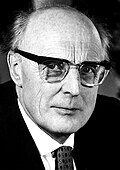
 West Germany
Explanation
The atomic nucleus is like a tiny onion with several layers inside. Ms. Goeppert-Mayer and Mr. Jensen called each layer a "shell." When a shell is completely filled, the nucleus becomes very stable. It’s similar to the electron shells you learn about in school. Their idea helps explain why elements like gold or iron can exist stably.
Related Keywords
shell model
A theory assuming nucleons move independently in a mean potential. Orbital energy levels form a hierarchy analogous to electron shells. Key features include explanation of magic numbers, the importance of spin–orbit coupling, and extensions to pairing interactions. It reproduces many experimentally observed excitation spectra. It is the most widely used framework for modern nuclear-structure calculations.
magic number
A proton or neutron number at which a shell closes, making the nucleus especially stable. Typical values are 2, 8, 20, 28, 50, 82, and 126. The shell model derives them theoretically and they serve as indicators for the limits of nuclear existence and super-heavy element synthesis.
spin–orbit interaction
An effect coupling a nucleon’s intrinsic spin to its orbital angular momentum. Including a strong spin–orbit term aligns shell structures with experimental data. Similar mechanisms appear in atomic fine structure and topological materials. It determines selection rules and transition probabilities.
mean-field approximation
A method that simplifies many-body interactions by replacing them with a one-body potential. It underlies the shell model, Hartree–Fock, and density-functional methods. Accuracy is improved with residual interactions or pairing terms. It is also applied to many-electron systems and quantum dots.
Woods–Saxon potential
An empirical potential shape that describes the diffuse surface of the nucleus. Using it in shell-model calculations separates bound from continuum states appropriately. It is particularly effective for heavy or deformed nuclei.
Pauli exclusion principle
A principle stating that fermions such as nucleons cannot occupy the same quantum state. It limits occupancy to 2j+1 nucleons per shell and helps generate magic numbers. It also affects electron shell structures and metallic conductivity.
Nilsson diagram
A plot showing how energy levels shift when a nucleus is deformed. It visualizes level crossings driven by spin–orbit coupling and deformation parameters. It is a tool for analyzing shell structures and rotational bands.
pairing interaction
An effect in which like nucleons bind in Cooper-pair-like states, lowering energy. Including it in the shell model explains even-odd effects and nuclear superfluidity. It contributes to mass formulas and β-decay half-lives.