1970 Nobel Prize in Physics(1)
Reason for Award
for fundamental work and discoveries in magnetohydro-dynamics with fruitful applications in different parts of plasma physics
Laureates
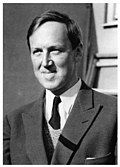
 Sweden
Explanation
In space and in laboratories there is a special kind of gas called "plasma" that carries electricity. Dr. Alfvén studied how this plasma moves when it is mixed with magnetic forces. Just like water can swirl inside a hose, plasma can flow along magnetic lines and make waves. He called these ripples "Alfvén waves." Thanks to Alfvén waves we now understand how the solar wind from the Sun reaches Earth. The same ideas help us design magnetic shields that protect satellites.
Related Keywords
magnetohydrodynamics
Magnetohydrodynamics (MHD) unifies the equations of electromagnetism and fluid dynamics to describe conductive fluids such as plasmas and liquid metals. Because Maxwell’s equations and the Navier–Stokes equations are solved together, unique phenomena like magnetic field freezing and dynamo action emerge. The Alfvén wave is a linear solution of these equations and a key to understanding solar and cosmic plasmas. MHD underpins fusion-reactor stability studies and global magnetosphere simulations, and has even been explored for electric-power generation in MHD turbines. Alfvén’s Nobel-winning work essentially established this field, which remains a cornerstone of plasma science.
plasma
Plasma is a state of matter in which gas becomes so hot that electrons and ions move freely, allowing it to conduct electricity. Over 99 % of visible matter in the universe is plasma, forming the solar wind and filling interstellar space. Because of its high conductivity it couples strongly to magnetic fields and is analyzed with MHD. In laboratories plasma is used in fluorescent lights, plasma TVs, and fusion experiments, and in industry for surface processing. Alfvén extended the theoretical understanding of cosmic plasma, laying the foundation for explaining phenomena around Earth and in the solar atmosphere.
Alfvén wave
An Alfvén wave is a transverse wave that travels along magnetic field lines, generated when plasma particles and magnetic-field tension act like a spring. Its speed is the Alfvén speed, increasing with stronger magnetic fields and lower densities. The wave is crucial for energy transport in coronal heating and magnetospheric substorms. It has been detected directly by satellites and ground magnetometers, confirming theoretical predictions. Alfvén waves are also exploited for plasma heating and antenna coupling, and in fusion devices they are investigated alongside ion-cyclotron waves as a means of energy deposition.
solar wind
The solar wind is a continuous outflow of charged particles from the Sun’s corona, and it drives space weather that causes auroras and communication disturbances on Earth. As a plasma it carries magnetic fields and propagates Alfvén waves and shocks throughout the heliosphere. Alfvén’s MHD theory is essential to interpreting the solar wind’s behavior. Spacecraft have measured its density, velocity, and magnetic field in detail, allowing comparison with theory. The solar wind is now recognized as a key factor in planetary exploration and spacecraft operation.
magnetosphere
The magnetosphere is the region where Earth’s magnetic field deflects the solar wind, containing the Van Allen belts and auroral zones. MHD waves and reconnection processes within it drive energy transport and particle acceleration. Alfvén waves constitute one of the magnetosphere’s natural oscillation modes and are identified through frequency analysis of ground magnetic fluctuations. Space-weather forecasting relies on magnetospheric simulations that incorporate Alfvén’s equations. The field is directly relevant to satellite operations and mitigation of geomagnetic-storm-induced power-grid failures.
plasma confinement
Plasma confinement refers to the phenomenon and technology of keeping plasma within a defined region, whether in fusion reactors or planetary magnetospheres. In tokamaks and stellarators, toroidal magnetic fields guide charged-particle trajectories. MHD instabilities determine confinement quality, and Alfvén-wave resonances can enhance energy transport. Researchers employ magnetic shear and rotational control to suppress unstable modes. Alfvén’s foundational theory is the starting point for such analyses and is directly applied in projects like ITER.
space plasma physics
Space plasma physics studies plasmas in regions where electromagnetic forces are as important as gravity, such as interplanetary space, planetary magnetospheres, and stellar environments. Scientists combine spacecraft observations with MHD simulations to investigate mechanisms of solar storms and magnetic reconnection. Alfvén waves and shocks are key agents in high-energy particle acceleration, another central topic. The field is tightly linked to Earth’s environment and the safety of space travel, leading to global collaborative observation networks. Alfvén’s theory supplies a common language that unifies analytical methods across the discipline.