1970 Nobel Prize in Physics(2)
Reason for Award
for fundamental work and discoveries concerning antiferromagnetism and ferrimagnetism which have led to important applications in solid state physics
Laureates
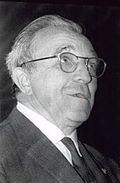
 France
Explanation
We all know magnets that stick to iron, but there are different kinds of magnetism. Dr. Néel discovered materials that behave differently from ordinary magnets. One is antiferromagnetic: tiny internal magnets line up opposite to one another so the overall magnetism cancels out. Another is ferrimagnetic: the cancellation is incomplete, leaving a weaker net magnetism. Understanding these behaviors lets us design materials for recording tapes and electronic parts, helping us store music or run smartphones.
Related Keywords
antiferromagnetism
Antiferromagnetism is a magnetic order in which neighboring spins align oppositely so that the macroscopic magnetization vanishes. Although its field response is weak, the ultrafast terahertz-range spin dynamics make AFM materials promising for next-generation memory. Order persists only below the Néel temperature and disappears into paramagnetism when heated. Magnetic structures can be observed by neutron diffraction or resonant X-ray scattering. Néel’s theory provides design rules for AFM materials and is pivotal in spintronics research.
ferrimagnetism
Ferrimagnetism is a state where unequal spins align antiparallel, leaving a net magnetization. Many magnetic ceramics (ferrites) are ferrimagnetic, offering excellent high-frequency performance and chemical stability. Raising temperature can drive the magnetization to zero at a compensation point, a feature exploited for temperature-tunable magneto-optical devices. Néel’s two-sublattice model provides a quantitative description and underlies magnetic-media development. Current research investigates garnet materials and rare-earth–transition-metal alloys for magnetic-switch applications.
Néel temperature
The Néel temperature is the critical temperature at which antiferromagnetic or ferrimagnetic order breaks down. When thermal fluctuations exceed the exchange-interaction energy, spins become disordered and the material turns paramagnetic. It manifests experimentally as a heat-capacity peak or a change in magnetic susceptibility. The parameter is essential for designing operating temperatures of magnetic devices and is widely referenced in functional materials such as rare-earth manganites. It is named in honor of Louis Néel’s contributions.
spin
Spin is a quantum-mechanical form of angular momentum carried by electrons and nuclei, and is the source of magnetic moments. The orientation and interactions of spins determine a material’s magnetic properties. Néel theorized that when the exchange interaction favors antiparallel alignment, antiferromagnetism arises. Today the field of spintronics exploits devices that manipulate both electric current and spin, with new functions such as chiral skyrmions and spin-rectification attracting attention. Spin control is expanding into quantum computing and medical imaging applications.
magnetic structure
Magnetic structure describes the pattern of spin arrangement in a crystal and is categorized as G-type, C-type, A-type, etc., depending on lattice geometry. It can be observed directly via magnetic X-ray diffraction or neutron scattering and is key to understanding electronic correlations. Since Néel’s discovery, complex multi-q magnetic structures have been studied in layered manganites and heavy-electron systems. Competition between magnetic order, superconductivity, and multiferroicity remains a hot topic. Structural models are compared with first-principles calculations, accelerating new-material discovery.
magnetic recording media
Magnetic recording media, such as hard disks and tapes, store data by orienting magnetization domains. To achieve high density, ferrimagnetic or antiferromagnetic storage layers with small grain size and high anisotropy are needed. Néel’s theory predicts the temperature and size at which particles become superparamagnetic, essential for evaluating recording lifetime. Current research explores bit-patterned media and AFM-based memory devices, employing heat-assisted recording that leverages control around the Néel temperature. The field underpins the information age.
exchange interaction
The exchange interaction is an effective spin–spin interaction that arises from quantum mechanics, combining Coulomb forces with the Pauli principle. A positive sign stabilizes ferromagnetism, while a negative sign favors antiferromagnetism. Néel showed that crystal-structure-dependent exchange pathways can flip the sign and proposed the superexchange mechanism. Exchange constants are determined by first-principles calculations or inelastic neutron scattering and serve as input parameters for magnetic simulations. Controlling the interaction is crucial for spintronics and quantum-information devices.