2005 Nobel Prize in Physics(1)
Reason for Award
For his contribution to the quantum theory of optical coherence. In a series of papers, including Phys. Rev. Lett. 10 (1963) 84-86, Phys. Rev. 130 (1963) 2529-2539, and Phys. Rev. 131 (1963) 2766-2788, he created a consistent framework that treats light as both particles and waves.
Laureates
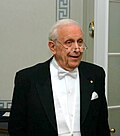
 United States of America
Explanation
Light we see from bulbs or lasers comes in many forms. Dr. Glauber found a way to explain that light is made of tiny "light particles" called photons and at the same time spreads out like waves. Thanks to his ideas, we can study the light from stars or traffic lights much more precisely. DVD players and the clear pictures from smartphone cameras also build on this work. Dr. Glauber gave us a key to understand the mystery of light.
Related Keywords
quantum optics
A field that treats the electromagnetic field quantum-mechanically, focusing on photon statistics and correlations. It underpins laser cooling, quantum communication, and quantum computing. Glauber’s work sparked its birth; today it extends to vacuum engineering and spin-photon interfaces.
optical coherence
A measure of phase alignment in light waves. First-order coherence gives clear interference fringes; higher orders appear in photon statistics. Lasers have high coherence, incandescent bulbs low. Coherence preservation is crucial in quantum communication.
photon bunching
The tendency of photons from thermal light to arrive in clumps. Quantified by g^{(2)}(0)>1. First observed in the HBT experiment and explained by Glauber. Applied to stellar diameter measurements in astronomy.
photon antibunching
A signature of non-classical light in which simultaneous photons are suppressed, giving g^{(2)}(0)<1. It is a quality metric for single-photon sources and vital for quantum cryptography and sensing.
Hanbury Brown and Twiss effect
An effect using correlations between two detectors to infer source size. Explainable classically and quantum-mechanically, but photon statistics are central in the quantum picture. Used in astronomy and quantum imaging.
photo-detection theory
A theoretical framework describing photon absorption and electron emission with quantum operators. Employs normal ordering and correlation functions. Sets the fundamental noise limits of optical sensors.
quantum electrodynamics
The quantum-relativistic field theory of electromagnetic interactions. Predicts vacuum polarization and anomalous magnetic moments with high precision. Glauber’s detection theory is an early application of QED to the visible-light domain.